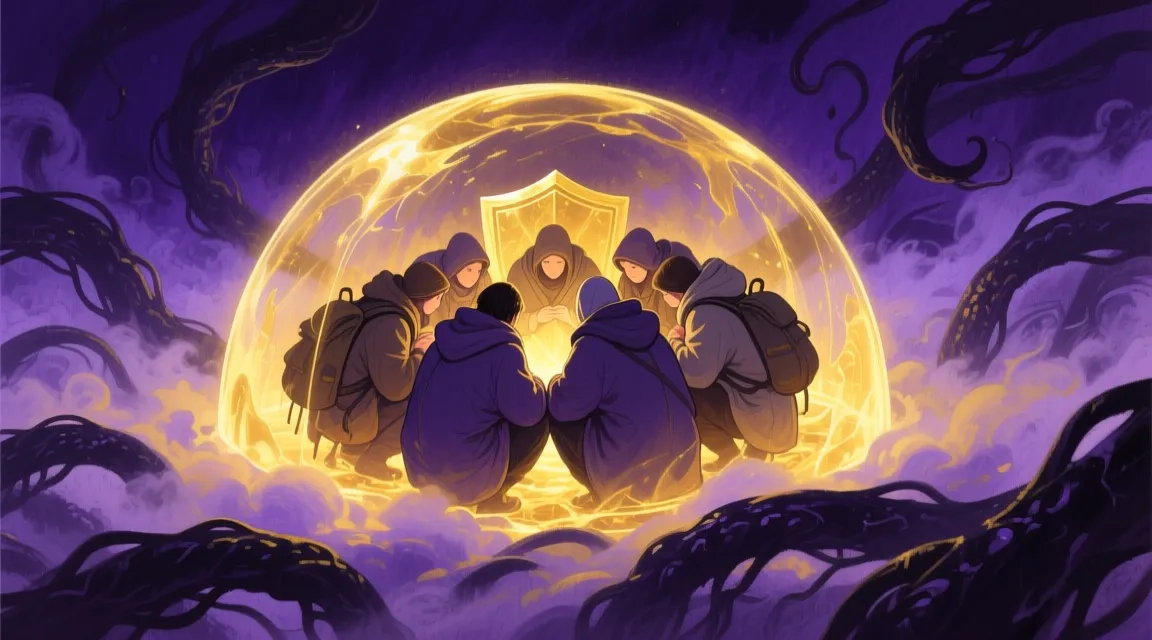
Nowhere Land explores dark themes, horror, existential dread, and cosmic mystery. These tools exist so you can explore the void safely — knowing that the people at the table matter more than any story. Safety tools are not optional. They are foundational.
Why This Chapter Exists
Why This Chapter Exists
Role-playing games create real emotional experiences. Even fictional content — a villain's monologue, a domain's body horror, the Count's manipulation — can trigger genuine distress. Safety tools are not restrictions on your creativity. They are the brakes on a car: they let you drive faster because you know you can stop.
Trust Enables Darkness
Players who feel safe take more creative risks. The darkest stories emerge when everyone knows there's a safety net.
Everyone Is Different
Trauma, neurodivergence, identity, past experiences — what's thrilling for one player may be devastating for another. You can't predict this.
Consent Is Ongoing
Boundaries aren't set once and forgotten. They shift with mood, life events, and the story itself. Check in constantly.
The Table Is Real
Characters are fictional. Players are not. What happens at the table affects real people with real emotions, real bodies, and real lives outside the game.
The Roleplayer's Violentomètre
Adapted from the original Violentomètre (a domestic violence awareness tool by the Observatoire des violences envers les femmes de Seine-Saint-Denis and En Avant Toute(s)), this graduated meter helps you evaluate whether the dynamics at your table are healthy, concerning, or dangerous. It covers relationships between players, game masters, and the social contract of play.
- 1.Safety tools have been explained and everyone can use them without judgment (X-Card, Veil, etc.).
- 2.My gender identity, pronouns (they/he/she), and chosen name are respected by everyone. No questioning my body or past.
- 3.I can express disagreement about a rule without fear of punishment, ridicule, or exclusion by the GM.
- 4.The GM regularly checks in on everyone's comfort. Fatigue, hypersensitivity, and neuro-atypical needs are acknowledged.
- 5.Everyone has equal opportunity to speak and shine. No one is talked over, and attention is shared equitably.
- 6.I can leave the table or take a break (sensory, restroom, quiet time) at any moment without justifying myself or suffering in-game consequences (Open Door).
- 7.Difficult themes (horror, romance, violence) were discussed before play and everyone agreed to explore them (Session Zero).
- 8.Feedback is constructive — given to improve and grow together, not to hurt or humiliate.
- 9.Even when I fail a dice roll, the story continues and stays interesting. I'm not punished or blocked for bad luck (Fail Forward).
- 10.We play 'with' each other, not 'against' each other — unless everyone explicitly agreed to competitive mode (PvP).
- 11.People mock my play style, my level of immersion, or my character choices.
- 12.A player condescendingly explains rules or my own character's story to me as if I were a child.
- 13.The GM invents or changes a rule on the spot specifically to prevent me from succeeding at something that annoys them.
- 14.Another player constantly dictates what I should do, leaving me no autonomy or freedom of choice (Micro-management).
- 15.'Historical realism' or humor is used to justify racist, sexist, or homophobic jokes at the table.
- 16.I feel pressured to laugh at crude or borderline jokes so I won't be 'the one who ruins the mood.'
- 17.Female characters or characters from minorities are always portrayed as caricatures or hyper-sexualized.
- 18.People roll their eyes, sigh, or mock me when I ask to use a safety tool or change the subject.
- 19.The GM or a player sulks, gets angry, or pouts because the story isn't going their way.
- 20.I keep playing a scene that makes me uncomfortable just to avoid 'ruining the mood' or bothering others.
- 21.I'm made to feel I'm not a 'real gamer' because of my gender, disability, experience level, or preferred game system (Gatekeeping).
- 22.The GM deliberately uses a trauma or painful event from my past (or my character's) to genuinely hurt me.
- 23.Someone deliberately refuses to use my pronouns or chosen name, or uses my dead name to provoke me (Intentional misgendering/deadnaming).
- 24.Inappropriate comments are made about my appearance, gender, or sexual orientation outside the game (Discord, breaks, etc.) (Out-of-character harassment).
- 25.A player or the GM insists heavily on forcing romance or sexual scenes after I've already said no.
- 26.The excuse of 'it's what my character would do' is used to justify toxic, harassing, or aggressive behavior toward my character (My Guy Syndrome).
- 27.I'm told I'm 'ruining the game' or I'm 'too sensitive' because I expressed a need for safety or respect.
- 28.Scenes of violence become sadistic, overly detailed, or sexualized without serving the story, making everyone uncomfortable.
- 29.I'm deliberately ignored, excluded from group conversations, or not spoken to because I dared to complain (Social isolation).
- 30.The RPG is used as a pretext to express racist, xenophobic, or hateful opinions that the player genuinely holds (Disguised hate speech).
- 31.Racist, sexist, homophobic, or transphobic insults are used — whether in-game or out of game (Direct harassment).
- 32.Scenes of rape, torture, or sexual assault are imposed on my character after I said 'NO' or used a safety tool (Imposed sexual violence).
- 33.I'm touched without my consent — simulated combat, physical contact, roughhousing — whether in-game or outside (Non-consensual physical contact).
- 34.Threats to reveal my personal information (Doxxing), out my queer/trans identity to my family (Outing), or harm my real reputation (Real-world threats).
- 35.A player or GM obsessively harasses me via private messages (Discord, SMS, email) outside game hours (Stalking).
- 36.I fear for my immediate physical or emotional safety. This is an absolute emergency.
Adapted for tabletop RPG from the original Violentomètre by the Observatoire des violences envers les femmes de Seine-Saint-Denis and En Avant Toute(s). Inclusive edition inspired by community safety resources.
Core Safety Tools
These tools are your rights at the table. Learn them, use them, and never apologize for doing so.
The X-Card
Created by John Stavropoulos (2013) — CC BY-SA 3.0
A card with a large X placed on the table. Any participant — player or Trickster — can tap or hold up this card at any time to signal discomfort. The group immediately changes, rewinds, or skips the content.
Key Rule
No explanation required. You never have to say why. Just tap the card and the scene changes.
N-Card — Signal that content is heading toward a boundary. 'We're approaching a line.' The group adjusts before crossing it.
O-Card — Signal positive consent: 'I'm okay, continue.' Can be prompted by asking 'O?' to check in with the table.
Lines & Veils
Created by Ron Edwards (Sex and Sorcery, ~2002)
Lines (Hard No)
Content that never appears in the game. No exceptions, no narrative justification, no 'but it's realistic.' If someone draws a Line, it's absolute.
Veils (Fade to Black)
Content that can exist in the fiction but is handled off-screen or abstractly. 'We know it happened; we don't narrate the details.'
Establish Lines & Veils during Session Zero. Create a shared document that players can update anonymously at any time. When a Line is approached, redirect immediately. When a Veil is reached, say: 'We fade to black here...'
Script Change
Created by Beau Jágr Sheldon (2013–2023) — CC BY 4.0
A nuanced toolkit using film editing metaphors that gives every player director-level control over the narrative. More granular than X-Card.
Pause (||)
Stop all activity. Take a bio break, center yourself, or discuss what's happening.
Rewind (<<)
Go back and change something that just happened. What originally occurred is not canon.
Fast-Forward (>>)
Skip to the end of this scene. Content happened but isn't described. 'Fade to black.'
Frame-by-Frame (|>)
Slow down through sensitive content. The GM pauses regularly to check in. Say 'resume' when safe.
Two Thumbs Up (2TU)
Silent check-in. Five-point scale from 'all okay' (👍👍) to 'need a Rewind' (👎👎).
Resume (>)
Signal to return to play after any tool has been used.
The Open Door
Any player can leave the game at any time, for any reason, no questions asked. The door is always open. This includes taking a break, stepping outside for air, or leaving for the evening. No in-game consequences, no social pressure, no guilt.
OK Check-In
Silent check-in using a hand sign (like scuba diving's OK signal). Players can signal they're fine — or not — without disrupting play flow. Pair this with Script Change's Two Thumbs Up for more granularity.
Before Play: Session Zero
Session Zero is your safety foundation. Before any dice are rolled or any portal is opened, have this conversation.
Picks, Squicks & Icks
A three-tier system for mapping content boundaries (from Script Change):
Picks
Content players actively want to explore — bittersweet tones, cosmic horror, found family, mystery.
Squicks
Content that's uncomfortable or gross — handle with Rewind or Fast-Forward. Not traumatizing, but unpleasant.
Icks
Content to avoid entirely — triggering, traumatizing, or deeply distressing. If encountered accidentally, use Rewind/Pause immediately.
Content Ratings
Agree on a content rating for your game, like a film rating. You can set different ratings for different content types:
No graphic content. Suitable for all ages.
Mild tension. Violence referenced but not depicted in detail.
Moderate intensity. Violence, fear, and emotional distress present but not gratuitous.
Mature themes. Graphic violence, horror, and intense emotional content. Requires strong safety tools.
Example: 'Our Nowhere Land campaign is R-rated for horror and violence, PG-13 for romance, and has a hard Line on sexual violence.'
Session Zero Checklist
- Introduce and demonstrate all safety tools (X-Card, Script Change, Open Door)
- Establish Lines & Veils — create a shared, anonymous document
- Map Picks, Squicks & Icks for the campaign
- Set content ratings by category (violence, romance, horror, etc.)
- Discuss Nowhere Land-specific themes: identity loss, body horror, the Count's manipulation, cosmic dread
- Share preferred pronouns and chosen names — normalize this for everyone
- Agree on break schedules, session length, and fatigue signals
- Establish a private communication channel for between-session concerns
- Discuss neurodivergent accommodations (sensory needs, processing time, communication preferences)
- Create an anonymous feedback mechanism for ongoing concerns
- Agree on PvP boundaries and inter-character conflict limits
- Review the Violentomètre together — where does your table land?
Content Consent Checklist
Use this interactive checklist at Session Zero to map your table's boundaries. Each player rates their comfort level for potential content themes. This can be done privately (submitted to the Trickster) or as a group discussion.
Violence & Combat
Horror & Dread
Identity & Self
Relationships & Social
Nowhere Land Specific
This checklist is not exhaustive. Comfort levels change over time. Revisit after any session where safety tools were used.
Neurodivergent Player Safety
Neurodivergent Player Safety
Tabletop RPGs can be uniquely rewarding for neurodivergent players — and uniquely challenging. These accommodations aren't 'special treatment.' They're good table design that benefits everyone.
Sensory Breaks
The Open Door policy explicitly covers sensory overload. Dim lighting, loud voices, extended sessions — any of these can be overwhelming. Step away anytime.
Multiple Signaling Modalities
Not everyone can speak up in the moment. Provide alternatives: tapping the table, holding up a card, typing in chat, using emoji reactions, or angling an object. Script Change's variety of tools helps here.
Processing Time
Some players need more time to process intense scenes. Frame-by-Frame pacing lets you slow down. It's always okay to say 'I need a moment to think about that.'
No-Explanation Policies
X-Card's 'no questions asked' principle is essential. Having to justify discomfort is a barrier for many neurodivergent people. The boundary itself is enough.
Check-In Frequency
Neurodivergent players may not display distress in expected ways — or may mask their discomfort. Regular, explicit check-ins ('How are we all doing?') help catch what might be missed.
Fatigue Awareness
Executive function fatigue, social battery depletion, and masking exhaustion are real. Shorter sessions, planned breaks, and permission to leave early are reasonable accommodations.
Communication Preferences
Some players prefer written communication for feedback. Offer between-session check-ins via text or email in addition to verbal debrief.
Stimming & Fidgeting
Fidget toys, doodling, pacing — these help some people concentrate and regulate. They are not signs of disengagement. Welcome them at the table.
Queer & Gender-Inclusive Safety
Queer & Gender-Inclusive Safety
Nowhere Land is a world where identity is fluid, bodies transform, and the very concept of self is questioned by the domains. This makes queer and gender-diverse safety especially important — both because the themes resonate powerfully and because they can cut close to real experiences.
Pronoun Respect Is Non-Negotiable
At Session Zero, share pronouns. Use them consistently. Mistakes happen; correct yourself and move on. Deliberate misgendering or deadnaming is Orange/Red Zone behavior on the Violentomètre.
No Interrogating Bodies or Pasts
In-game or out, never question a player's body, medical history, or 'real' identity. Characters in Nowhere Land can be anyone; so can the players.
Identity Exploration Is Welcome
RPGs are powerful spaces for exploring gender, sexuality, and identity. Support players who want to try different pronouns, play characters of different genders, or explore queerness through fiction.
Outing Protection
Some players may be out at the table but not in their daily life. Never share a player's identity, orientation, or gender history outside the group without explicit permission.
Romantic & Sexual Content Boundaries
Establish Lines & Veils around romance and sexuality. Never assume players are comfortable with these themes based on their identity. Ask, don't assume.
Avoiding Stereotypical Representation
Challenge yourself and your players to create queer characters who aren't defined solely by their queerness. Avoid harmful tropes: the tragic queer character, the predatory trans villain, the comic relief gay best friend.
Crisis Resources
Know your resources: The Trevor Project (1-866-488-7386), Trans Lifeline (1-877-565-8860), and ILGA World for international resources.
During Play: Using the Tools
During Play: Using the Tools
Safety tools only work if they're normalized. Here's how to make them part of your table culture.
Normalize Tool Use
The Trickster should use safety tools themselves in the first session. Tap the X-Card to demonstrate. Use Pause for a bio break. This shows everyone that using tools is normal, not dramatic.
Check In Proactively
Don't wait for problems. Before intense scenes, ask: 'We're about to enter the Bone Gardens — everyone good?' Use Two Thumbs Up for a quick read of the table.
Beware 'My Guy Syndrome'
The phrase 'It's what my character would do' is the most common excuse for in-game abuse. If your character's actions hurt a player — not just their character — it's real harm. Character consistency never justifies ruining someone's experience.
Respect Calibration
When someone uses a safety tool, respond with action, not questions. 'Got it — let's rewind to before the Count's offer.' Don't explain, justify, or debate.
Watch for Quiet Distress
Not everyone speaks up. Watch for withdrawal, silence, nervous laughter, or sudden disengagement. A private check-in after the session can catch what real-time tools miss.
After Play: Debrief & Aftercare
Intense sessions leave emotional residue. Debrief helps separate player from character and ensures everyone leaves the table whole.
Stars & Wishes
A positive-focused end-of-session tool from the Gauntlet RPG community:
Star — Describe a moment you appreciated: great roleplay, a clever tactic, a considerate gesture.
Wish — Something you'd like to see more of in future sessions.
Highlight Reel
Each player shares their favorite moment from the session. Strictly positive — no criticism, no 'buts.' Celebrate the good.
Private Check-Ins
After particularly intense sessions, the Trickster should reach out to players individually (text, DM, email — not in the group chat). Simple: 'Hey, that was a heavy session. How are you feeling?'
Managing Bleed
Bleed is when emotions transfer between player and character. It's natural and can be powerful — but it needs aftercare. After sessions with intense Bleed, acknowledge it: 'We all felt heavy after that scene. Let's take a breath before we leave.'
- • What was your favorite moment?
- • Anything that made you uncomfortable?
- • How is your character feeling right now?
- • Is there anything you'd like to handle differently next time?
- • How are YOU feeling? (Not your character — you.)
Emergency Resources
Emergency Resources
If you or someone at your table is in immediate danger — physical, emotional, or psychological — these resources can help.
You are never overreacting. If something feels wrong, it is wrong — for you. Your safety at the table is more important than any story, any campaign, any friendship. Protect yourself first.
"The darkest portals lead to the deepest stories — but only when we hold each other's hands through the void."
— The Trickster's First Duty
See Also
For Tricksters: How to Facilitate Safety Tools
The Trickster's guide to running a safe table — facilitation techniques, intervention strategies, and advanced safety mechanics.
Introduction to Nowhere Land
Introduction to Nowhere Land and the core concepts of the game.
The Trickster's complete guide to running sessions, creating NPCs, and managing the game.